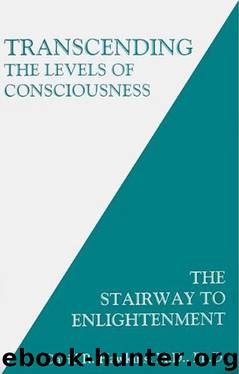
Transcending the Levels of Consciousness: The Stairway to Enlightenment by David R. Hawkins
Author:David R. Hawkins [Hawkins, David R.]
Language: eng
Format: epub
Tags: Body; Mind & Spirit, Self-Help, General, Spiritual, Spirituality
ISBN: 9780971500754
Google: imGpAAAACAAJ
Amazon: 0971500746
Publisher: Veritas Publishing
Published: 2005-12-15T19:32:04.992910+00:00
Discussion.
Consciousness levels below 350 reflect the domination of perception by emotionalized positions and presumed values. At levels below 200, the emotions are harsh, destructive, and adversarial, and thus prone to conflict and strife. At level 200, the emotionality moves away from negativity to a more positive view of the world and self and becomes supportive of life. By level 310, the emotionality and volition are predominantly positive but still represent emotional drives. At level 350, by acceptance, tranquility replaces disturbing emotions so that the interference of emotionality fades into the background rather than determines feelings.
At level 350, the narcissistic ego’s demand to control others is silenced by virtue of the cessation of value-driven judgmentalism and its innate desire to promulgate its views. Dualistic mentations diminish, as do judgments predicated on perceptions based on the dichotomy of good and evil. Choice presents itself as freedom of options rather than as opposing moralistic categories.
At the world’s level of consciousness, to choose vanilla means to see chocolate as a rival, an enemy, or a quality to be hated. At level 350, there is the freedom to see that they are merely alternate options and one can choose one flavor without demonizing the other. Thus, there is release from the coercion that ensues from labeling options as severe degrees of desirability or aversion.
Critical to this level is the utilization of the previously achieved capacity for Willingness (which was acquired at level 310). The success of level 350 is based on the willingness to apply the principle of forgiveness in order to counterbalance morality and judgmental-ism. Thus, vindictiveness is replaced by mercy, which allows for greater inner, as well as interpersonal and social, harmony and well-being. Error is seen to be in need of correction, forgiveness, and compassion rather than the justification for punitive attitudes or actions.
The surrender of judgmentalism is resisted by the ego’s inflationary self-importance gained by viewing itself as righteous and a sovereign arbiter of moral worth. Acceptance does not require denial but instead replaces it by realistic perception and recognition of its innate limitation. It does not feel compelled to ‘take a stand’ about what is perceived or to take action and feel compelled to ‘fix it’. Therefore, Acceptance can see and accept the limitations of human life and the world of distortions without losing its balance and equanimity.
Acceptance is a result of wisdom as well as surrendering positionalities in that it accepts that the varied expressions of life are in accord with Divine will and that Creation is thereby multitudinous in its expressions as evolution. Acceptance does not get caught in the ‘either-or’ of ‘black and white’ duality and is able to bypass the temptation of judgmentalism. Acceptance sees that perceived qualities are innate to the human condition and are reflective of individual as well as group karma and innate to the species Homo sapiens. Society includes an admixture of different levels of evolutionary development, including a panorama of options and alternate ways to go in the existential ‘house of mirrors’.
Download
This site does not store any files on its server. We only index and link to content provided by other sites. Please contact the content providers to delete copyright contents if any and email us, we'll remove relevant links or contents immediately.
| Anthropology | Archaeology |
| Philosophy | Politics & Government |
| Social Sciences | Sociology |
| Women's Studies |
The remains of the day by Kazuo Ishiguro(9004)
Tools of Titans by Timothy Ferriss(8403)
Giovanni's Room by James Baldwin(7352)
The Black Swan by Nassim Nicholas Taleb(7137)
Inner Engineering: A Yogi's Guide to Joy by Sadhguru(6799)
The Way of Zen by Alan W. Watts(6621)
The Power of Now: A Guide to Spiritual Enlightenment by Eckhart Tolle(5790)
Asking the Right Questions: A Guide to Critical Thinking by M. Neil Browne & Stuart M. Keeley(5779)
The Six Wives Of Henry VIII (WOMEN IN HISTORY) by Fraser Antonia(5519)
Astrophysics for People in a Hurry by Neil DeGrasse Tyson(5196)
Housekeeping by Marilynne Robinson(4455)
12 Rules for Life by Jordan B. Peterson(4312)
Ikigai by Héctor García & Francesc Miralles(4279)
Double Down (Diary of a Wimpy Kid Book 11) by Jeff Kinney(4278)
The Ethical Slut by Janet W. Hardy(4262)
Skin in the Game by Nassim Nicholas Taleb(4257)
The Art of Happiness by The Dalai Lama(4133)
Skin in the Game: Hidden Asymmetries in Daily Life by Nassim Nicholas Taleb(4012)
Walking by Henry David Thoreau(3968)
